by Abhishek Katakwar
The GLP-1 Plateau: Why a Higher Dose Isn’t Always the Answer.
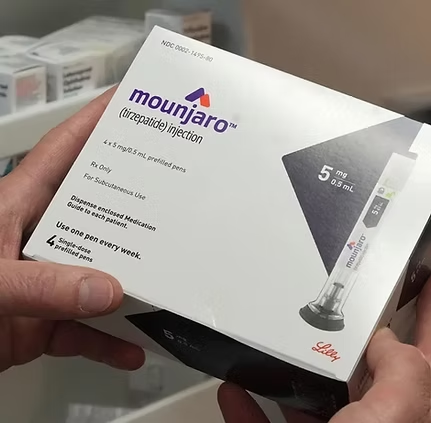
In the modern era of metabolic medicine, GLP-1 receptor agonists (like Semaglutide and Tirzepatide) have revolutionized how we treat obesity. However, a common and frustrating phenomenon occurs in clinical practice: the plateau.
When weight loss stalls, many patients—and some providers—instinctively reach for a higher dose. But as a surgeon and metabolic specialist, I often tell my patients at AIG Hospitals and ODDS Clinic that "force" is not a substitute for "strategy."
If you are currently facing a stall, here is the clinical evidence on why you need a PLAN, not just more medication.
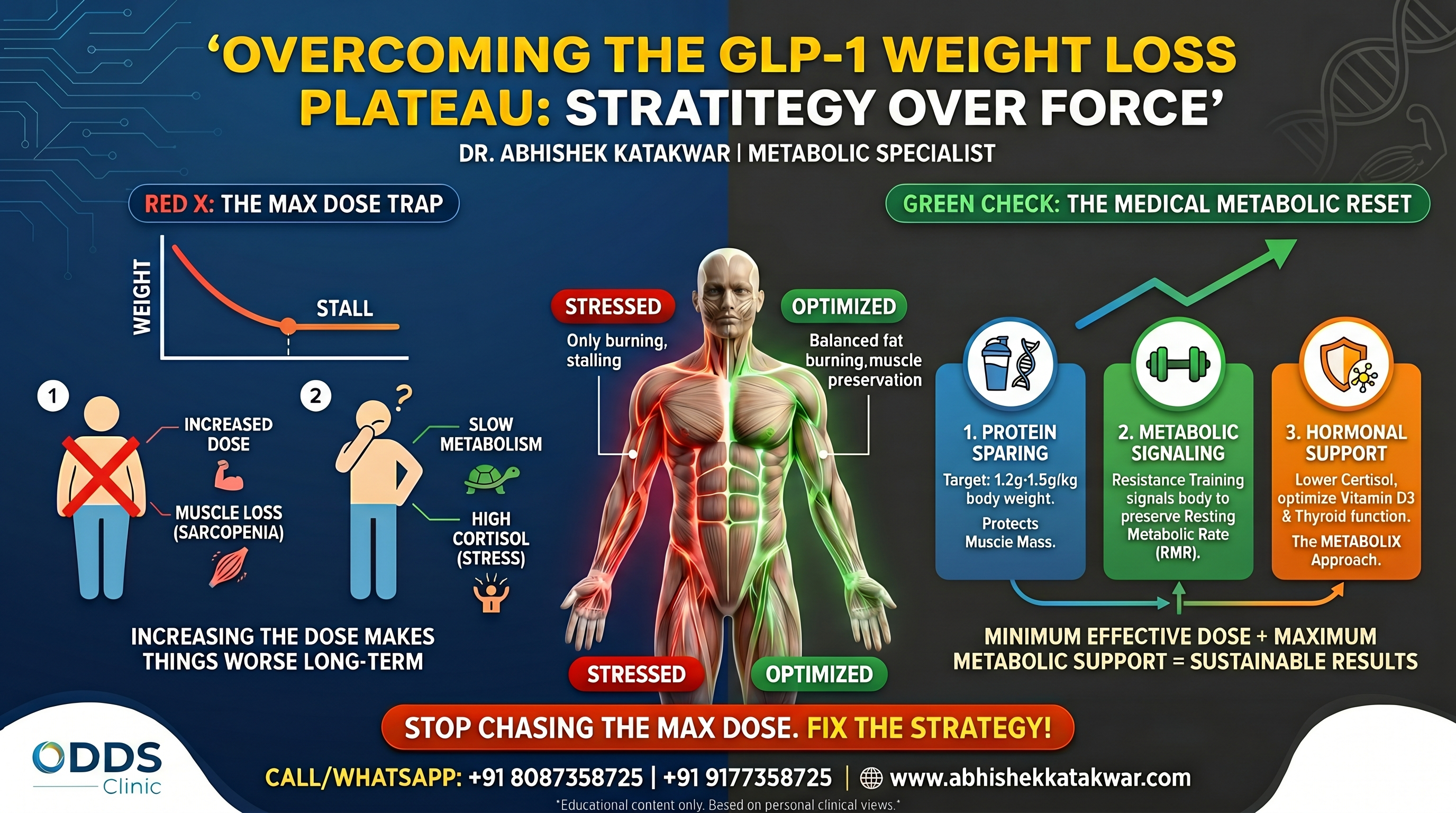
A weight-loss plateau is rarely a failure of the medication; it is often a success of your body’s survival mechanisms. According to Level 1 clinical evidence, your body utilizes several pathways to defend its weight:
Metabolic Adaptation: As you lose weight, your Resting Metabolic Rate (RMR) drops. Your body becomes "efficient," burning fewer calories to perform the same daily tasks.
The Cortisol Spike: Constant caloric restriction and the physical stress of rapid weight loss can elevate cortisol. High cortisol levels promote water retention and visceral fat storage, masking true progress.
Sarcopenia (Muscle Loss): If protein intake is insufficient, the body breaks down muscle tissue for energy. Since muscle is your primary metabolic engine, losing it ensures a future plateau.
Increasing the dose during a plateau without fixing the underlying strategy can lead to a "crash and burn" scenario. Higher doses can suppress appetite so severely that protein intake drops to dangerous levels. This accelerates muscle loss, further slowing your metabolism and making it nearly impossible to maintain your results long-term.
To break a plateau, we must shift the body from a state of "starvation defense" to a state of "metabolic efficiency." This is what we call the Medical Metabolic Reset.
Clinical studies in high-indexed medical journals suggest that to preserve lean mass during GLP-1 therapy, one should aim for 1.2g to 1.5g of protein per kg of body weight. This ensures that the weight you lose is fat, not the muscle that keeps your metabolism running.
You must give your body a reason to keep its muscle. Resistance training signals the body that muscle tissue is "essential." Without this signal, the body will prioritize burning muscle over fat during a deficit.
We look beyond the scale at markers like Vitamin D3, Magnesium, and thyroid function. Using the METABOLIX approach, we ensure your cellular health is supported so your hormones can function optimally.
Medication is a powerful tool, but it is the strategy surrounding that tool that determines your long-term success. If your results have slowed down, it’s time to stop chasing higher doses and start optimizing your metabolic foundation.
At ODDS Clinic, we don't just prescribe; we provide a roadmap for a complete health reset.
Ready to break your plateau?
If you want to move beyond the "maximum dose" trap and start a scientifically-backed plan, I am here to guide you.
Dr. Abhishek Katakwar
Associate Director, Center for Obesity and Metabolic Therapy, AIG Hospitals
Founder, ODDS Clinic
📞 WhatsApp: +91 8087358725
🌐 Website: www.abhishekkatakwar.com
📍 Visit: AIG Hospitals, Gachibowli, Hyderabad
#abhishekkatakwar #ODDS_CLINIC #MetabolicHealth #WeightLossJourney #AIGHospitals
(Disclaimer: This content is for educational purposes only. Always consult with your healthcare provider before making changes to your medication or treatment plan. Based on personal clinical views and Level 1 & 2 evidence.)

Address : Cluster K, AIG Hospitals, Beside Ramky Towers, 1, Mindspace Rd, Hyderabad, Telangana 500032
abhishekkatakwar@gmail.com Phone : +91-8087358725 Phone : +91-9177358725© 2026 Dr. Abhishek Katakwar. All Rights Reserved.